



This practical guide explains how to choose the right condom size, material, and fit for comfort and safer use. You’ll also find a quick sizing method, common mistakes to avoid, and a FAQ section.
CONTENT
- → The Benefits of Condoms and Why They Are Important
- → Types and Selection of Condoms
- → Quick Choice: Which Condom Should You Pick?
- → How to Properly Use Condoms
- → Condoms or Hormonal Contraceptives
- → Common Mistakes (and How to Avoid Them)
- → FAQ: Condoms Size, Materials & Safe use
TL;DR: How to Choose the Right Condom
- Choose condom size based on nominal width for a secure fit and better protection.
- If condoms feel too tight, select larger sizes; if they slip, choose snug or slim fit options.
- Ultra-thin condoms increase sensitivity, while thicker condoms may help reduce sensitivity and last longer.
- Non-latex condoms are a safe alternative for people with latex allergies.
- Correct use from start to finish is essential to reduce the risk of pregnancy and STIs.
WHY IS IT IMPORTANT TO USE CONDOMS FOR PROTECTION?
Protection Against STIs and HIV
Condoms provide significant protection against many sexually transmitted infections, including HIV, gonorrhea, chlamydia, and syphilis. While the last three infections are treatable with timely and proper care, HIV is incurable and can only be managed with antiretroviral therapy (ART).
Prevention Unplanned Pregancy with Condoms
There is a belief that pregnancy can be avoided if ejaculation does not occur inside the vagina. However, this is not entirely accurate for several reasons:
Pre-ejaculate Fluid: During sexual arousal, pre-ejaculate fluid (pre-cum) is released, which may contain sperm. If this fluid enters the vagina, there is a risk of pregnancy.
Contact of Sperm with the Vagina: If sperm comes into contact with the vaginal area (e.g., external genitalia or nearby), it can enter and lead to pregnancy.
Interrupted Coitus Failure: The withdrawal method (where the penis is removed from the vagina before ejaculation) requires precise control and timing. Even a slight delay can result in sperm entering the vagina.
Although the chance of pregnancy under such conditions is lower than with full ejaculation inside, it still exists. Therefore, for reliable contraception, it is recommended to use additional protective measures, such as condoms, which are one of the most effective contraceptive methods when used correctly.
Effectiveness at a glance:
- Without contraception, the chance of pregnancy is about 85% within one year of regular unprotected sex.
- With correct condom use, effectiveness reaches up to 98%.
- With typical use, condoms are about 85% effective due to human error.
Additional Benefits of Condoms
Temporary and Reversible Effect: Condoms do not affect long-term fertility and can be used during each sexual act, making them ideal for those who do not want permanent or long-term contraceptive solutions.
Diversity and Enhanced Pleasure: Condoms come in various textures, flavors, and sizes, and even glow-in-the-dark options, which can enhance sexual pleasure for both partners.
Encourages Communication: Using condoms can foster open communication between partners about sexual health and contraception.
Boosts Confidence and Psychological Comfort: Condoms can provide a psychological sense of security and control, reducing anxiety related to unplanned pregnancy. Knowing a contraceptive method is in use can alleviate tension and contribute to a more relaxed state. Additionally, for some men, condoms may create an extra layer of confidence and protection, reducing stress and improving self-control.
Reduces Sensitivity: Condoms can decrease sensitivity of the penis, which helps prolong sexual activity. This is particularly true for condoms with thicker walls or those containing special anesthetics (e.g., benzocaine) applied to the inner surface to reduce sensitivity.
No Hormonal Side Effects: Unlike some other contraceptive methods, condoms do not contain hormones, avoiding side effects such as weight gain, mood changes, or blood clotting.
TYPES OF CONDOMS AND HOW TO CHOOSE THE RIGHT ONE
Be sure to check the packaging or product description before purchasing, where you can find information and characteristics such as quantity, size, material, color, lubricant, shape, thickness, length, width, features, and effects.
CONDOM SIZE: How to Choose the Correct Fit
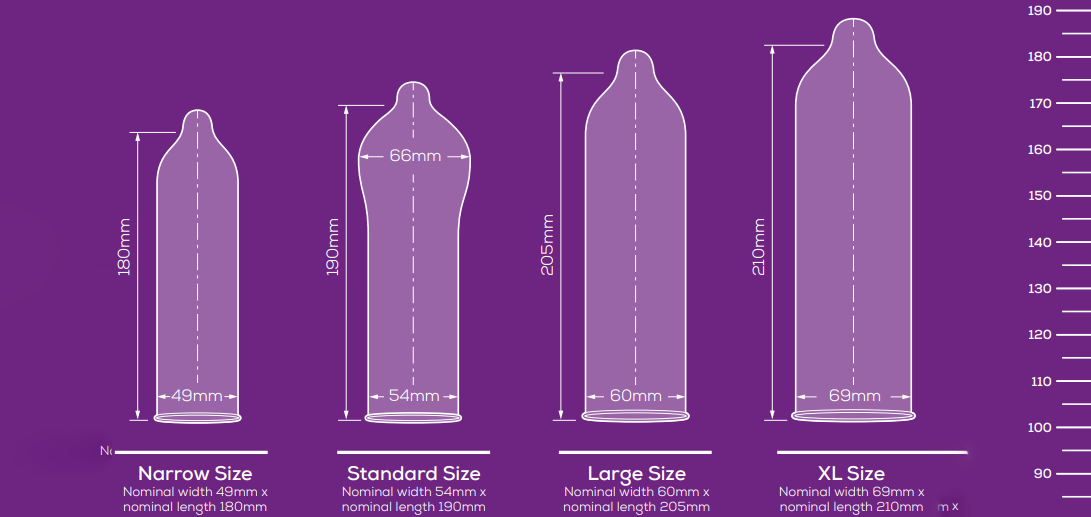
It is very important to choose a condom of the correct size (width and length). Condoms that are too small can tear and cause discomfort, while those that are too large may slip off. The condom should fit securely at the base and comfortably along the length of the penis. You can measure the length and girth of the erect penis to select the appropriate size.
Standard: Suitable for most men.
Large and Extra-Large: For men who find standard condoms too tight.
Snug Fit: For those who find standard condoms too loose.
Condom sizes are usually indicated on the packaging.
Condom Size Comparison Across Regions
Choosing the right condom size is crucial for comfort and effectiveness.
Measurements are given in both millimeters (mm) and centimeters (cm) for easy reference.
How to Measure for the Right Condom Size:
- Measure Girth: Measure the circumference of your erect penis at mid-shaft using a soft measuring tape or a strip of paper.
- Calculate Nominal Width: Divide the measured girth (in millimeters) by 2 to estimate the nominal width.
- Check the Size Table: Compare your result with the size chart to find the closest matching condom size.
- Choose the Best Fit: A well-fitting condom should feel secure without being uncomfortably tight or loose.
Condom size comparison table: This table shows nominal width, length, and common size names used in the EU, UK, US, Japan, and Russia to help you choose the best-fitting condom.
If you are between two sizes, choosing the slightly smaller size usually provides a more secure fit. Proper measurement helps reduce the risk of slipping or breakage and improves overall comfort.
| Nominal Width | Length | EU Size Name | UK Size Name | US Size Name | Japan Size Name | Russia Size Name | Popular EU/UK Brands | Popular US Brands | Popular Japan Brands | Popular Russia Brands |
|---|---|---|---|---|---|---|---|---|---|---|
| 49 mm (4.9 cm, 1.93 in) | ~17-19 cm (~6.69-7.48 in) | Small/Slim Fit | Slim Fit/Small | Small, Slim,Snug Fit | Original 0.01, Slim, Regular | Маленький (Small) | Durex Close Fit, Pasante Trim | Trojan ENZ, Lifestyles Snugger Fit | Okamoto, Sagami, Skin | Sico Slim Fit, Vizit Classic |
| 52 mm (5.2 cm, 2.05 in) | ~18-20 cm (~7.09-7.87 in) | Standard/Regular | Regular/Standard | Standard, Regular | Regular | Стандартный (Standard), Classic | Durex Classic, Pasante Regular | Trojan Ultra Thin, Lifestyles Ultra Sensitive | Okamoto, Sagami, Skin | Contex Classic, Vizit Luxe |
| 54 mm (5.4 cm, 2.13 in) | ~19-21 cm (~7.48-8.27 in) | Regular+ | Larger Regular | Larger Standard | Regular | Стандарт+ (Standard+) | Pasante King Size | Trojan Magnum | Okamoto, Sagami, Skin | Sico Plus, Luxe Maxima |
| 56 mm (5.6 cm, 2.20 in) | ~19-22 cm (~7.48-8.66 in) | Large | Large | Magnum Large, Regular | Big Boy, Regular | Большой (Large) | Durex Comfort XL, Pasante Large | Trojan Magnum Large | Okamoto, Sagami, Skin | Contex Extra Large |
| 60 mm (6.0 cm, 2.36 in) | ~20-22 cm (~7.87-8.66 in) | XL/Extra Large | XL | Extra Large, Magnum XL, XXL | Big Boy, XL | Очень Большой (Very Large), XL, XLL | Pasante Super King | Trojan Magnum XL | Okamoto, Sagami, Skin | Vizit XXL, Contex Imperial |
| 69 mm (6.9 cm, 2.72 in) | ~22-23 cm (~8.66-9.06 in) | XXL/King Size | King Size/XXL | XXL | XXL | Королевский (King Size), XXL | My.Size 69, Durex XXL | Trojan Magnum XXL | Okamoto, Sagami, Skin | Vizit King, Sico XXL |
Key Takeaways:
- Nominal Width: Measured when the condom is laid flat. Double this number to approximate the circumference.
- Length: Indicates the total length of the condom in its unstretched state.
- Size Names: Different regions use various terms like "Slim Fit," "Regular," or "Large," but the dimensions are often standardized.
- Popular Brands: EU/UK markets are dominated by brands like Durex and Pasante, while Russian markets feature Vizit and Contex.
Ensure you measure your own girth and length to select the most comfortable and effective fit. Proper condom sizing enhances safety and satisfaction during use.

Condom Thickness and Sensitivity Levels:
Ultra-Thin: Offers high sensitivity but requires careful use.
Thin: A balance between standard and ultra-thin.
Standard: Provides a balance between protection and sensitivity.
Thick: For those who want to prolong the act and ensure extra protection.
Thickness scales are often found on condom packaging.

Materials of Condoms:
- Latex Condoms: The most common type, effective but may cause allergies in some people. They provide good protection against infections and pregnancy.
- Non-Latex Condoms: Made from materials such as polyurethane or polyisoprene, suitable for people with latex allergies.
- Natural Membrane Condoms: Made from sheep intestines, offering a natural feel but are less effective against STIs.
Special Condoms:
- Flavored Condoms: Designed for oral sex, available in various flavors to enhance taste.
- Female Condoms: Worn inside the vagina, offering an alternative to male condoms.
- Internal Condoms: Similar to female condoms but can also be used anally.
- Glow in the Dark Condoms: A novelty option that glows in the dark for added fun.
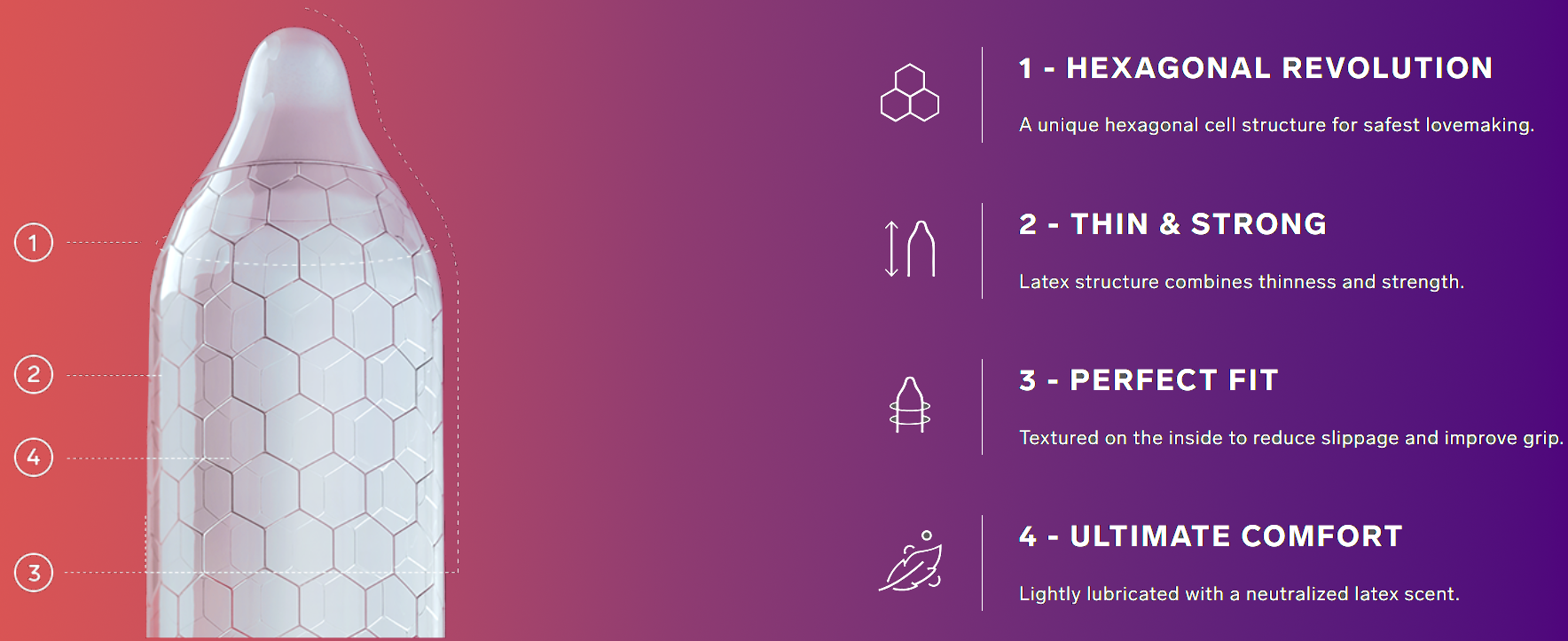
Hexagonal cell structure (HEX):
These ultra-thin condoms provide unmatched sensations and a perfect fit. Thanks to the famous hexagonal structure, textured inside for better grip, these are the best condoms you've ever tried.
Material: Natural latex
Thickness: 0.055-0.060 mm
QUICK CONDOM CHOICE GUIDE
If condoms feel too tight: Choose Large or XL condoms and check nominal widths around 56–60 mm for a more comfortable fit.
If condoms slip or feel loose: Try Snug Fit or Slim Fit condoms (around 49 mm) to improve grip and reduce the risk of slipping.
If you want maximum sensitivity: Ultra-thin condoms provide increased sensation and a more natural feel, but require careful use and proper sizing.
If you have a latex allergy: Choose non-latex condoms made from polyisoprene or polyurethane for safe and comfortable protection.
If you want extra comfort: Opt for lubricated condoms or add a compatible water-based or silicone-based lubricant to reduce friction.
For oral sex: Flavored condoms are designed specifically for oral use and can enhance comfort and taste.
HOW TO USE CONDOMS PROPERLY
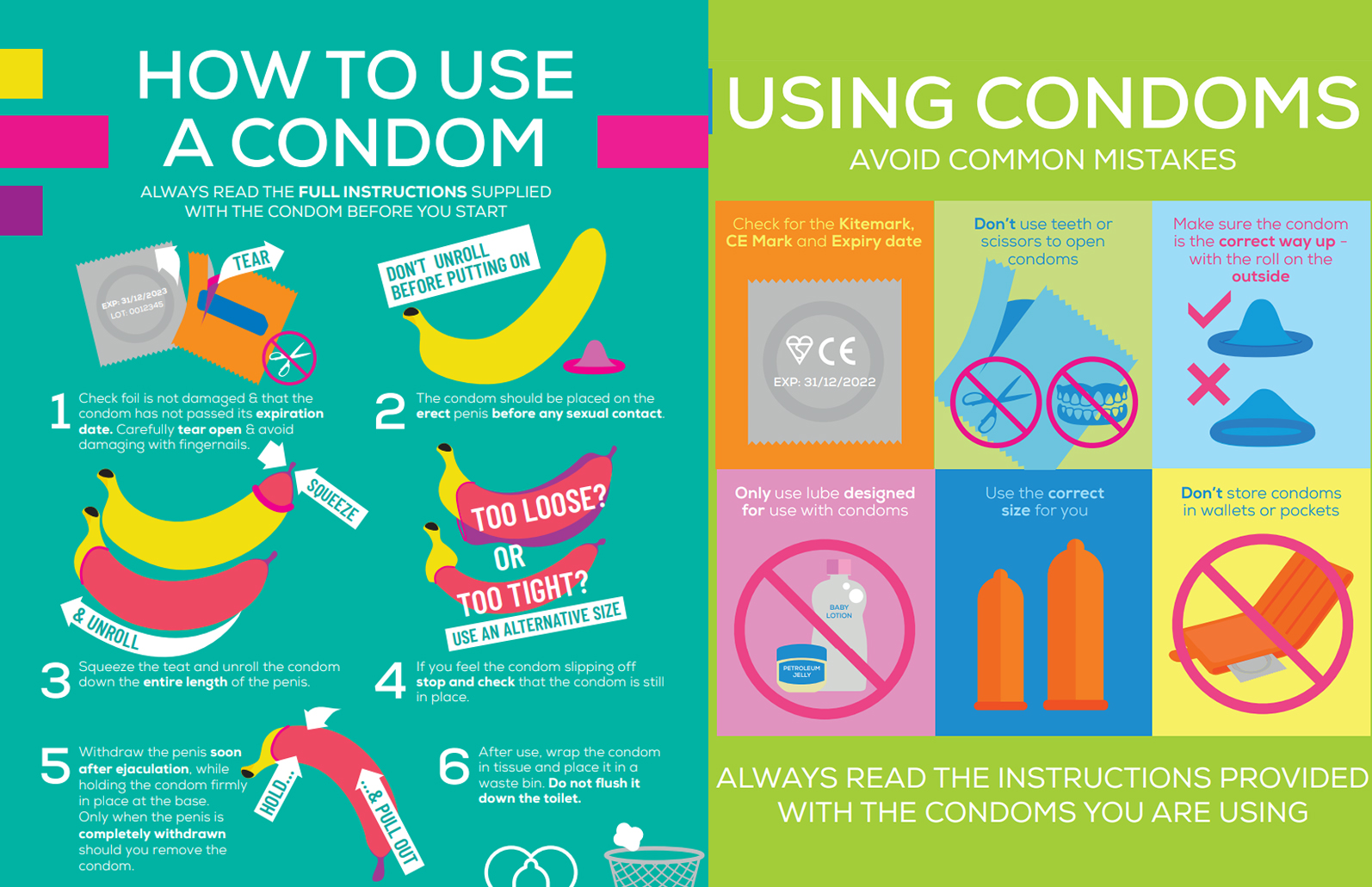
1. Check the packaging - make sure it is undamaged and not expired.
2. Open the package carefully to avoid damaging the condom. Do not use teeth or scissors.
3. Putting on the condom:
- Place the condom on an erect penis.
- Pinch the tip of the condom to remove air and leave space for semen.
- Roll the condom down to the base of the penis.
4. Use water-based or silicone-based lubricants. Oil-based lubricants (like petroleum jelly) can damage latex condoms.
5. After ejaculation - hold the base of the condom while withdrawing to prevent it from slipping off. Carefully remove the condom, tie it in a knot, and dispose of it.
6. Additional tips:
- Store condoms in a cool, dry place, avoiding direct sunlight and high temperatures.
- Use a new condom for each sexual encounter.
- Never reuse a condom.
Proper use of condoms not only helps prevent unwanted pregnancies and protects against infections but can also contribute to more confident and comfortable sexual relationships.
CONDOMS VS. HORMONAL CONTRACEPTIVES
Disadvantages of Condoms:
- Lower effectiveness compared to hormonal methods (about 85% with typical use and 98% with correct use).
- Must be used correctly every time to achieve high effectiveness.
- Some people may have an allergy to latex (latex-free options are available).
- May reduce arousal and sensitivity during sexual activity (in some cases, this could be an advantage).
Disadvantages of Hormonal Contraceptives:
- No protection against sexually transmitted infections (STIs).
- Possible side effects (e.g., nausea, weight gain, mood changes).
- Requires a prescription and regular medical check-ups.
- Some methods require daily, weekly, or monthly attention.
Both methods have their unique advantages and disadvantages, and the choice depends on individual needs, health conditions, and lifestyle preferences.
On the one hand, hormonal contraceptives are generally more effective at preventing pregnancy compared to condoms when used correctly. However, they fall short compared to condoms in protecting against sexually transmitted infections (STIs), as well as in convenience, cost, and accessibility. Additionally, hormonal contraceptives can have side effects and require medical supervision and consistent planning.
COMMON CONDOM MISTAKES AND HOW TO AVOID THEM
Choosing the wrong size: Condoms that are too small may feel uncomfortable and can increase the risk of tearing, while condoms that are too large may slip off. Measuring girth and checking the nominal width helps ensure a proper fit.
Opening the package incorrectly: Using teeth, scissors, or sharp objects can damage the condom without being noticeable. Always open the package carefully with your fingers.
Not leaving space at the tip: Failing to pinch the tip before rolling the condom down can trap air, which increases the chance of breakage.
Using incompatible lubricants: Oil-based lubricants can weaken latex condoms and reduce their effectiveness. Water-based or silicone-based lubricants are safer unless the packaging states otherwise.
Putting the condom on too late: Condoms should be used from the very beginning of sexual contact to ensure proper protection.
Incorrect removal after ejaculation: After ejaculation, hold the base of the condom while withdrawing to help prevent slipping or leakage.
Improper storage: Heat, sunlight, and friction can degrade condoms. Store them in a cool, dry place and always check the expiration date and packaging condition.
FAQ: CONDOM SIZES, MATERIALS AND SAFE USE
What does “nominal width” mean?
Nominal width is the condom’s width when laid flat. It is a standard sizing measurement used by manufacturers. Doubling this number gives an approximate circumference.
How do I know if a condom is too small or too large?
If a condom feels uncomfortably tight or leaves deep marks, it may be too small. If it slips off easily, wrinkles excessively, or feels loose at the base, it may be too large.
Are non-latex condoms as safe as latex condoms?
Non-latex condoms made from polyisoprene or polyurethane are a good alternative for people with latex allergies. Always use them according to instructions for effective protection.
Can I use oil-based lubricants with condoms?
Oil-based lubricants can damage latex condoms and reduce their effectiveness. Water-based or silicone-based lubricants are recommended unless the product packaging states otherwise.
What condoms are best for sensitive skin?
For sensitive skin, consider non-latex condoms without added fragrances or irritating substances. Choosing a compatible lubricant can also improve comfort.
Do ultra-thin condoms break more easily?
Ultra-thin condoms are designed to provide more sensation while remaining reliable when used correctly. Selecting the right size and using proper lubrication reduces the risk of breakage.
Can condoms expire and how should they be stored?
Yes, condoms can expire. Store them in a cool, dry place away from direct sunlight and heat, and always check the expiration date before use.
Which condoms are best for oral sex?
Flavored condoms are designed specifically for oral sex and can improve comfort and taste. Make sure the size and lubrication are appropriate for safe use.
This article is for educational purposes and does not replace medical advice. Updated January 2026.
